
Reducing your environmental impact doesn’t have to mean sacrificing performance. In fact, companies implementing sustainability measures are achieving documented returns on investment, strengthening brand reputation, accessing premium markets, and preparing operations for tightening regulations. This guide outlines specific ways your company can reduce environmental impact, from greener chemical formulations to more resource-efficient processes.
What Are the Core Benefits of Sustainability?
Business sustainability offers the following benefits:
-
Cost savings: Upgrading to energy-efficient systems and minimizing waste improve margins in competitive bidding environments. According to a 2025 IEA survey, about 70% of industrial facilities reported a return on investment exceeding 10% from energy efficiency measures.
-
Market demand: Consumers and procurement teams actively seek suppliers with verified environmental credentials.
-
Competitive advantage: Companies that adopt sustainable practices gain market positioning that competitors struggle to replicate.
-
Improved brand reputation: Responsible, ethical operations strengthen customer loyalty and differentiate companies during client evaluations.
-
Talent attraction and retention: Eco-conscious companies with environmental commitments see higher employee engagement and retention rates.
-
Regulatory compliance: Proactive environmental measures prevent costly non-compliance fines. These practices prepare companies for evolving legislation before deadlines create urgency.
-
Investment appeal: Sustainability attracts capital from ESG-focused investors. It also builds long-term supply chain resilience against limited resources and volatile prices.
How Your Company Can Support Sustainability Efforts
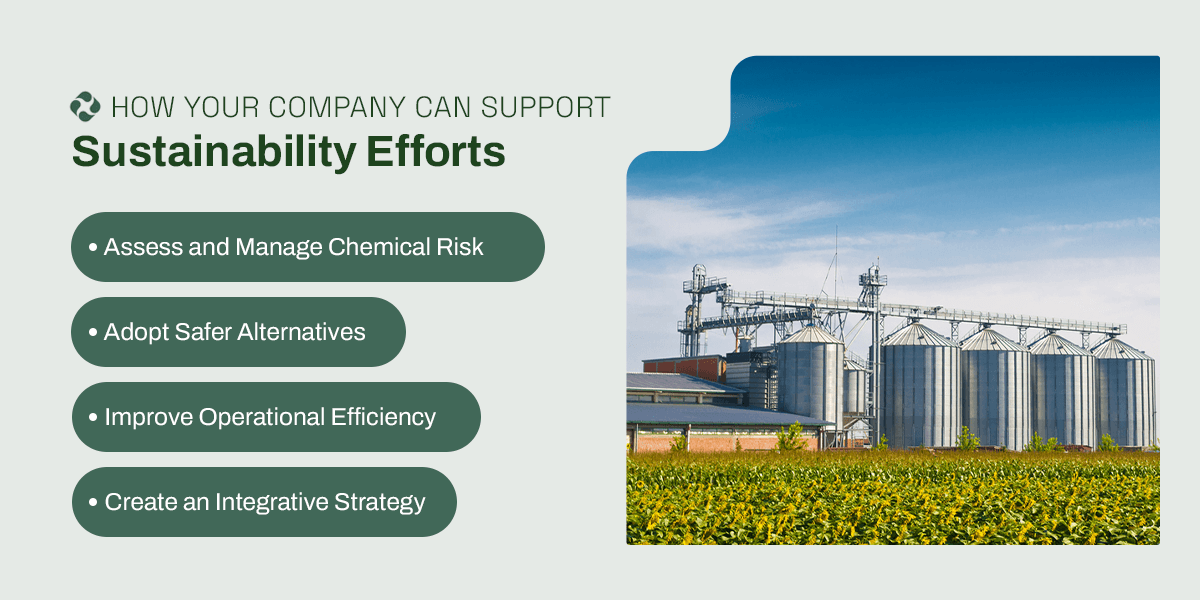
Industrial manufacturing sustainability calls for a systematic approach. These measures must address formulation hazards, operational efficiency and strategic planning. Here are several integrated strategies that help companies reduce their environmental footprint:
Assess and Manage Chemical Risk
Reducing chemical environmental impact begins with full hazard identification and control protocols:
-
Conduct environmental audits: Establish baseline measurements of formulation use, waste generation and emissions across all operational phases. These assessments identify high-impact reduction opportunities and quantify potential cost savings from substitution.
-
Implement SDS-based storage and handling: Software-defined storage procedures segregate incompatible formulations and prevent accidental releases. Deploy waste treatment systems before discharge, such as effluent treatment plants, to support compliance with local water quality standards.
-
Adopt documented risk management: These programs satisfy regulatory requirements. They also protect workers from exposure incidents that generate workers’ compensation claims and production delays.
Adopt Safer Alternatives
Substitution is another way to advance chemical sustainability. These strategies eliminate hazards at the source:
-
Develop biodegradable formulations: Create specialty non-toxic formulas rather than relying on personal protective equipment to manage exposure.
-
Use advanced technologies: Implement proprietary synthetic acid alternatives and nano-chemistry. These alternatives replace hazardous formulations without compromising performance in demanding applications.
-
Substitute for safer products: Substitution strategies reduce long-term health claims and regulatory scrutiny. Safer alternatives can reduce injury probability, lower insurance premiums and strengthen safety reputations during client audits.
Improve Operational Efficiency
Companies can achieve measurable efficiency gains through targeted improvements:
-
Optimize energy use: Energy optimization delivers immediate cost reductions and positions facilities to meet Net Zero commitments.
-
Use smart systems: Transition to renewable power sources where feasible and upgrade to smart systems that adjust consumption based on real-time demand.
-
Employ trained staff: Train staff on proper handling protocols and efficient formulation application techniques that minimize waste.
-
Prioritize certified disposal: Partner with certified disposal vendors who provide documented chain-of-custody records for hazardous waste streams.
Create an Integrative Strategy
Here are several ways companies can reduce chemical pollution:
-
Try executive-level integration: Embed sustainability metrics into your business strategy, rather than treating environmental initiatives as isolated compliance exercises.
-
Pursue EPA certifications: Certifications such as Design for the Environment and Generally Recognized as Safe status verify formulation safety.
-
Measure and report progress: Use standardized frameworks and communicate results to stakeholders through sustainability reports.
-
Cultivate relationships: Transparent documentation of environmental improvements strengthens relationships with investors, customers and regulatory agencies.
How Does Sustainability Fit Into Your Industry?
Manufacturers can reduce their environmental impact in many ways, depending on the industry:
Pétrole, gaz et mines
Solvent systems used in oil and gas operations are under intense scrutiny. This sector can target greenhouse gas reductions through operational electrification, reduced flaring and methane capture technologies. Both oil and gas and mining can invest in carbon capture and storage to neutralize emissions and maintain production volumes necessary to meet global energy demand.
Resource management in extraction requires massive water volumes, creating environmental stress in water-scarce regions. Sustainable practices include closed-loop water recycling systems, non-potable water sources and comprehensive land reclamation programs post-extraction.
Industriel
Industrial operations can make a positive impact with smart HVAC systems, on-site solar or wind generation, and lights-out manufacturing.
Through circular economy strategies, industrial facilities can prioritize recycled or bio-based raw materials. These alternatives stabilize expenses and reduce reliance on volatile commodity markets. Similarly, life cycle management approaches reuse industrial solid waste directly within production cycles. Efficient manufacturing minimizes environmental footprint and reduces disposal costs.
Transparent supply chains boost sustainability by improving vendor oversight and logistics. Staying ahead of regulatory mandates helps industrial companies avoid compliance penalties and capture financial incentives for reducing carbon emissions.
Traitement de l'eau
Water treatment facilities are transitioning toward zero-waste philosophies by treating and recycling wastewater for agricultural, industrial or potable reuse. Companies can lower consumption through energy-efficient pumps, advanced membrane filtration and renewable power integration, including solar arrays and energy-recovery systems.
Facilities also implement formulation reduction strategies by replacing harsh synthetic materials with nature-based solutions, biopolymers like chitosan and eco-friendly materials. By using constructed wetlands and aquifer recharge methods, nature-based infrastructure naturally filters and stores stormwater.
Agriculture
Many consumers and retailers demand transparent, traceable and sustainably sourced ingredients. This demand creates premium market access for certified agricultural operations.
For instance, farms can deploy precision agriculture technologies, including GPS-guided machinery, drones and AI sensors. With these technologies, they can apply exact amounts of water, fertilizer and pesticides, mitigating waste and runoff.
Soil health management is another effective practice. It prevents erosion, traps carbon and restores organic matter without heavy synthetic inputs. Transitioning from flood irrigation to drip systems and smart water recycling reduces energy consumption.
Désinfectant
By balancing antimicrobial efficacy with environmental and human health, disinfectant manufacturers make eco-conscious decisions that protect their bottom line. For example, companies can use eco-friendly formulations that replace toxic materials, such as ammonia or heavy bleach, with biodegradable or plant-derived ingredients.
Additionally, on-site generation technologies can use electrolyzed water to produce powerful, non-toxic sanitizers without harsh packaging or transport requirements. Concentrated formulas, refillable dispensing systems and recyclable or post-consumer recycled plastics minimize single-use waste.
Grow With Green Chemistry Alternatives
Sustainability drives resilience, market access and long-term profitability, all essential components of chemical industry leadership.
Heartland Energy Group LTD redefines industrial chemistries with sustainable solutions for businesses. We replace traditional harsh acids, solvents and caustics with safer, cutting-edge alternatives that deliver performance without compromising environmental responsibility.
Our specialty formulations are engineered for demanding industrial applications and are backed by over 100 years of combined team experience and EPA certifications. Whether you’re targeting emissions reduction, regulatory compliance or operational efficiency gains, our experts can identify substitution opportunities specific to your site.
Request a quote ou contact us to evaluate greener chemistry solutions. Call (877) 797-2811 today to speak with our team directly!
Messages populaires



Partenariat avec nous
S'aligner sur le groupe Heartland Energy
Contactez-nous dès aujourd'hui pour découvrir comment nos solutions sophistiquées peuvent améliorer vos opérations dans les secteurs du pétrole et du gaz, du traitement de l'eau, de l'exploitation minière, de l'agriculture, de la désinfection et de l'industrie. Ensemble, nous pouvons atteindre l'excellence opérationnelle et obtenir des résultats durables et percutants.