
Modern industrial operations face a rising tide of regulatory complexity and performance scrutiny. Buyers and operators across diverse sectors, from water treatment to mining, are being held to stricter industrial chemical regulations and are increasingly being called upon to eliminate hazardous legacy substances.
Regulations under the Toxic Substances Control Act (TSCA) and other emerging industrial chemical standards in the U.S. and European Union now demand comprehensive life-cycle thinking. Companies that proactively integrate safer formulations and robust documentation systems are set to realize long-term efficiency, reduced liability and stronger customer confidence.
Regulatory and Standards Landscape for Industrial Formulations
There have been significant regulatory changes in recent years aimed at protecting workers and communities while promoting innovation in safer chemistry.
EPA Amendments to the New Chemicals Review Process
The U.S. Environmental Protection Agency (EPA) finalized several amendments in December 2024 under the Toxic Substances Control Act (TSCA) to close historical loopholes for per- and polyfluoroalkyl substances (PFAS) and persistent, bioaccumulative and toxic (PBT) substances. As of January 2025:
- All new PFAS and qualifying PBTs are ineligible for Low Volume Exemptions (LVE) or Low Release and Exposure Exemptions (LoREX).
- Full pre-manufacture reviews are now required for any PFAS anticipated to enter U.S. commerce.
- The rule applies a robust safety assessment framework aligned with the Lautenberg Chemical Safety Act of 2016.
- The update streamlines data collection, requiring manufacturers to submit more detailed pre-manufacture notices (PMNs) and supporting documentation through the EPA’s Central Data Exchange.
Revisions to TSCA Section 6: Risk Evaluation Framework
The EPA’s revised rule for TSCA Section 6 would fundamentally change how existing industrial substances are evaluated. Rather than assessing all conditions of use together, the Agency plans to conduct separate evaluations for each use case, such as production, downstream processing, or disposal. The goal is to enhance clarity and focus on specific exposure pathways, particularly in occupational settings.
These revisions would also allow the EPA to consider existing exposure controls, including engineering measures and personal protective equipment, when determining potential risk. For manufacturers, this represents an opportunity to demonstrate compliance through robust workplace safety systems and documented engineering controls.
Extended Compliance Deadlines for High-Impact Substances
The EPA’s interim final rule, issued in September 2025, extended compliance deadlines for trichloroethylene (TCE) in critical infrastructure and national security applications. Specific facilities handling or disposing of TCE in wastewater now have until late 2026 to transition to alternative formulations. The use of TCE as a processing aid in nuclear fuel manufacture was extended to September 2028. While these extensions offer relief for critical infrastructure applications, most TCE uses remain prohibited.
Safer Choice and Design for the Environment (DfE) Standards
EPA’s Safer Choice and Design for the Environment (DfE) programs have become cornerstone frameworks for verifying product safety and environmental responsibility. Updated in August 2024, the latest Safer Choice Standard strengthens ingredient disclosure, performance validation and packaging sustainability requirements.
How the Safer Choice/DfE Standard Works
The Safer Choice program evaluates every ingredient in a formulation, not just the active compound. Every component in a formulation is reviewed against the Master and Functional-Class Criteria, covering surfactants, solvents, chelating agents, preservatives and other functional groups. Only ingredients meeting the lowest-hazard thresholds within their class qualify for certification.
2024–2025 Safer Choice Updates
The EPA issued several updates to the Safer Choice standard in August 2024, with implementation timelines stretching into 2025. Notable changes include:
- More stringent criteria for functional use classes like enzymes, fragrances and defoamers.
- New certification for cleaning service providers that use Safer Choice- or DfE-certified products.
- Revised packaging criteria to reduce plastic and improve recyclability.
- Formalized termination procedures for partnerships not meeting compliance benchmarks.
The EPA also added 18 new substances to the Safer Chemical Ingredients List (SCIL) in July 2025, expanding the catalog of approved ingredients for certified products.
Key Challenges Facing Industrial Process Manufacturers
Adopting safer and more sustainable chemicals introduces opportunities and complexities. Industrial producers face several recurring challenges as they align with modern industrial chemical regulations and manufacturing trends:
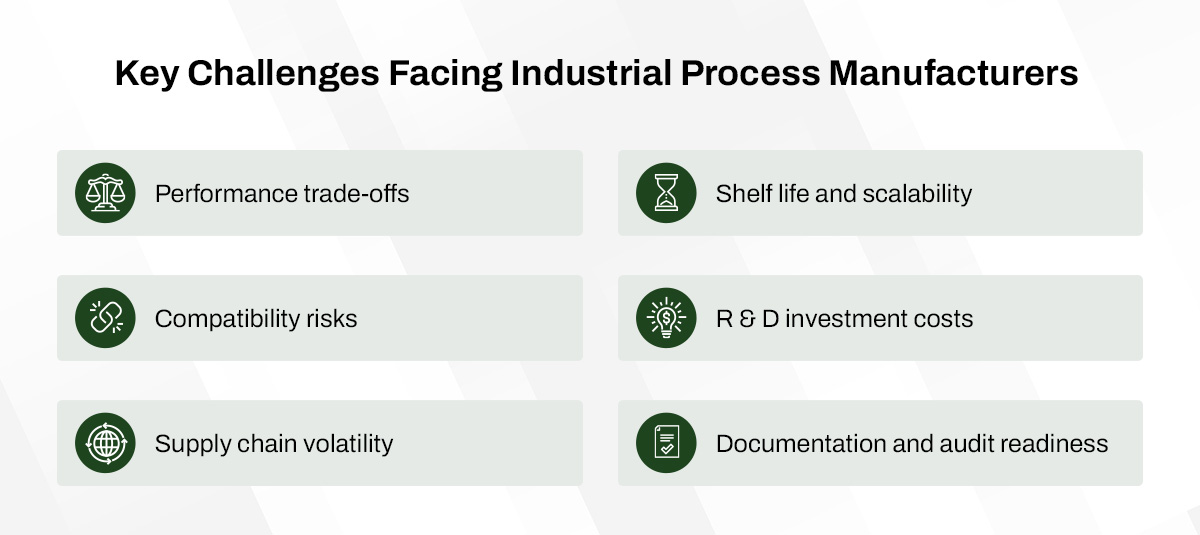
- Performance trade-offs: Replacing hazardous substances without compromising cleaning, degreasing or descaling capabilities can be challenging. Safer alternatives must match functional performance while reducing hazard profiles.
- Compatibility risks: New formulations must avoid corrosion and degradation of pumps, seals and piping to avoid safety incidents and unplanned downtime.
- Supply chain volatility: Sourcing verified, high-purity raw materials that meet current chemical restrictions can be difficult.
- Shelf life and scalability: Transitioning to safer inputs can affect product shelf life or alter stability during transit and storage. Even minor shifts in pH or temperature sensitivity can influence long-term performance.
- Research and development investment costs: Redesigning formulations around updated industrial chemical standards requires up-front investment in research and development, internal testing and — where applicable — third-party certifications. For smaller firms, this barrier can slow adoption.
- Documentation and audit readiness: The burden of maintaining updated Safety Data Sheets (SDS), exposure control plans, hazard communication protocols and audit documentation continues to grow as regulators push toward transparency and life cycle reporting.
Strategies for Compliance and Transition
A phased, evidence-based approach can help manufacturers maintain compliance and operational efficiency in response to evolving chemical regulation standards. Consider these strategies:
- Conduct a gap assessment: Start by evaluating your current formulations against updated chemical restrictions under TSCA, Registration, Evaluation, Authorisation and Restriction of Chemicals (REACH) and Federal Insecticide, Fungicide, and Rodenticide Act (FIFRA). Identify inputs that are banned, limited or under scrutiny and benchmark your SDS documents against the latest industry guidance.
- Screen for green replacements: Use EPA tools such as the Safer Chemical Ingredients List (SCIL) to identify viable, low-hazard alternatives. These ingredients have already passed EPA toxicological evaluations and provide a head start toward future certification.
- Pilot testing and field validation: Before full-scale adoption, test new formulations alongside existing products in representative use conditions to ensure optimal performance.
- Phased rollouts: Implement new formulations gradually. Begin in less critical systems where you can closely monitor performance. Once validated, extend deployment across primary production units.
- Build a certification roadmap: Work directly with the EPA or qualified third-party partners to navigate certification under the Safer Choice or DfE programs. Certification milestones typically include ingredient disclosure, formulation review, packaging evaluation and environmental testing. Early engagement with certification partners helps accelerate approval timelines.
- Strengthen supplier partnerships: Collaboration with upstream suppliers can unlock access to safer ingredients and improve quality control. Establishing joint R&D or co-manufacturing agreements ensures consistent compliance and helps mitigate sourcing risks related to chemical restrictions.
- Train and document internally: Update SDS, develop new SOPs, and train personnel in the correct handling and benefits of the safer alternatives. Establishing digital audit trails and automated reporting tools also enhances transparency during inspections or third-party audits.
Why Trust Heartland Energy Group LTD
Heartland Energy Group LTD has been advancing safer industrial formulations since 2006. With more than a century of combined technical expertise, we continue to lead in developing innovative alternatives that replace hazardous acids, caustics and solvents across key industries. Here are the benefits of partnering with us:
- Compliant by design: Our formulations are specifically designed to meet or exceed the EPA’s most recent standards. Many carry a triple-zero HMIS score and are non-corrosive, non-irritant and unregulated under U.S. Department of Transportation (DOT).
- Custom development: If your operation has unique process needs, we’ll work directly with your team to co-develop a solution tailored to your material, equipment and environmental constraints.
- National fulfillment with consistent quality: From Houston to North Dakota, we deliver with the same quality, batch consistency and shelf life you expect.
- Formulation validation: Our products demonstrate high performance in the field and meet or exceed green chemistry benchmarks.
- Industry-specific support: Whether you operate in mining, agriculture or water treatment, we understand the unique process realities and chemical regulation thresholds specific to your sector.
Partner With Heartland Energy Group LTD for Safer, Compliant Solutions
Heartland Energy Group LTD helps forward-looking organizations align operations with evolving industrial chemical standards. Whether you’re pursuing DfE certification, responding to a risk evaluation or transitioning away from PFAS and TCE, we provide reliable, field-tested formulations that minimize regulatory risk and deliver technical performance.
Let’s build a safer, more sustainable future together, starting with your next formulation. Call us at 877-797-2811 to speak with a green chemistry advisor or fill out the contact form to request a quote.
Publicações populares



Seja nosso parceiro
Alinhar-se com o Grupo Heartland Energy
Entre em contacto hoje mesmo para descobrir como as nossas soluções sofisticadas podem melhorar as suas operações nos sectores do petróleo e gás, tratamento de água, mineração, agricultura, desinfectantes e industrial. Juntos, podemos alcançar a excelência operacional e fornecer resultados duradouros e impactantes.